





As a significant contributor to global carbon emissions, the aviation industry has a unique responsibility to mitigate its environmental impact. For airports in Australia, the commitment to decarbonisation is not just about reducing emissions; it's about being at the forefront of a transformation in global travel and setting the standard for a more sustainable future.
Ultimately, decarbonisation is about building a future where aviation can continue to connect people and places while reducing its impact on the planet. See our approach to decarbonisation summarised here.
In May 2025, Sydney Airport achieved Airport Carbon Accreditation Level 4. This achievement was in recognition of Sydney Airport’s dedication and outcomes in aligning its carbon management with global climate goals to reach absolute emissions reductions. This achievement also recognises Sydney Airport establishing related partnerships with its business partners, as part of the Global airport industry’s response to the challenge of Climate Change.

Net Zero emissions by 2030 (Scope 1 and 2)
We are committed to achieving our target of Net Zero emissions (Scope 1 and 2) by 2030.
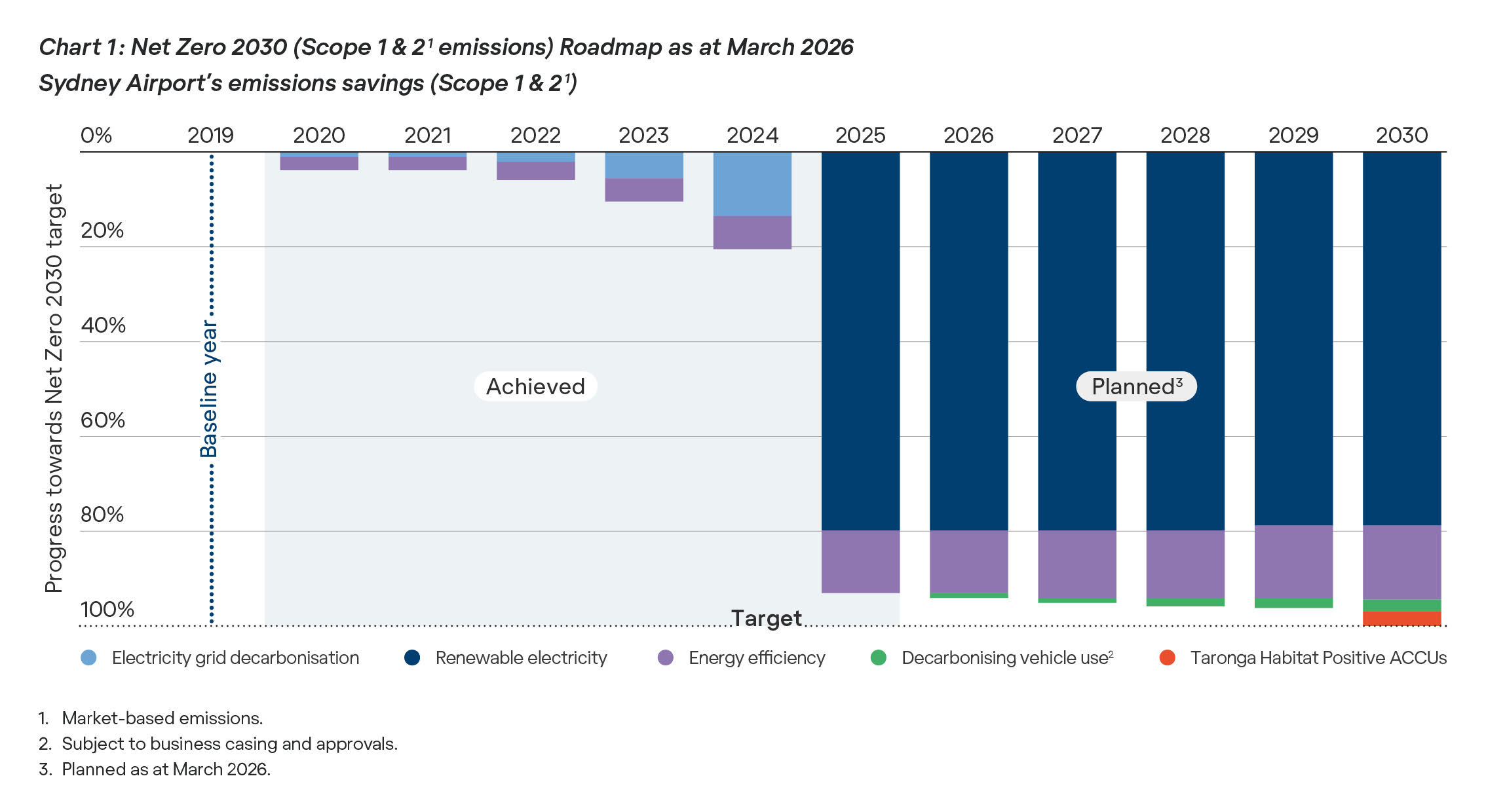
We have developed a detailed roadmap to support this commitment. This roadmap details the key initiatives that we plan to implement to reduce and eliminate our emissions (where feasible), and the estimated timing and potential emissions savings from these initiatives.
We made significant progress towards this target during the reporting period. As of 1 January 2025, Scope 2 market-based emissions have been reduced to zero by purchasing 100% renewable electricity and surrendering large-scale generation certificates which match Sydney Airport's consumption. Read more about our renewable electricity here.
The elimination of Scope 2 marked-based emissions contributed to a 93% reduction in emissions against the target baseline year.
Scope 3 emissions strategy
Scope 3 emissions constitute 99 percent of our total carbon footprint (including full-flight emissions). Reducing scope 3 emissions—those generated by the value chain, such as aviation fuel used for passenger travel—is one of the most important areas of our focus.
Our Scope 3 Strategy aims to decouple passenger growth from emissions growth and seize opportunities to work with airlines and the broader industry to decarbonise. Our Scope 3 Strategy prioritises emissions reduction initiatives with the largest emissions impact and where we have the strongest level of influence.

We recognise that the Scope 3 emissions landscape is uncertain, complex, often outside of our control and filled with interdependencies, which is why we have set long term ambitions for Scope 3 emissions instead of targets. This will allow us to evolve our Scope 3 ambitions over time in response to a rapidly changing environment and market expectations. We will strive for progress by actively partnering with our stakeholders and achieving common goals.

The largest-ever commercial importation of Sustainable Aviation Fuel (SAF) into Australia then to Sydney Airport, in partnership with Qantas, Ampol and the SAF Coalition May 2025.
Advocacy on Sustainable Aviation Fuel
As part of our approach to reduce Scope 3 emissions, Sydney Airport is advocating for a low carbon future for the aviation industry, helping to drive the development of a local Sustainable Aviation Fuel (SAF) industry through the following;
-
In May 2025, signing of a Memorandum of Understanding (MoU) between Qantas and Sydney Airport to work together to further facilitate the development of a domestic SAF industry in Australia through joint advocacy and research.
-
In May 2025, Sydney Airport, Qantas, Ampol and a coalition of leading Australian and International organisations made the largest ever commercial importation of SAF into Australia (nearly two million litres of neat SAF). Read more about this import on our Community Hub or in our Newsroom.
-
Sydney Airport’s long-term ambition for 50 percent of the fuel uplift at the airport by 2050 to be SAF.
-
Sydney Airport joined the Jet Zero Council as the airport representative in November 2025 as part of its participation in the AAA Sustainability Working Group, which is delivering Workplan item #5 (identifying changes required to airport operations and infrastructure that will support decarbonising aviation).
-
Sydney Airport is a member of Low Carbon Fuels Alliance of Australia and New Zealand (LCFAANZ) working group alongside aviation industry peers and fuel producers.
-
As part of Sydney Airport’s Aviation Green Paper submission, we worked with Melbourne and Brisbane airports, in collaboration with IFM Investors (one of SAAH owner groups), to form a joint airport advocacy position to advance a domestic SAF industry in Australia. Sydney Airport’s Aviation Green Paper submission can be found here.